The following month brings a fresh challenge which I will be documenting here later. In hindsight, I found this challenge a little underwhelming but that was probably because I only engaged with it in a fairly superficial way. It's not too different to the way I normally operate when I go out with my camera in the city so I didn't really feel that I had covered any new ground! Onwards and upwards.....
Showing posts with label black and white. Show all posts
Monday, 20 April 2015
12 by 12 Challenge #1 Part Two
Following on from the first part of my 12 by 12 challenge, I made the same journey but in reverse - from Baker Street tube to Marylebone Station. In her challenge Vanessa Winship made the point that taking the same route may well lead to a different experience on another occasion. Walking in the opposite direction perhaps you notice things you missed on the way there - it's certainly always good to have an alternative viewpoint. Other factors will influence the look of the street - time of day, weather, amount of people and traffic etc. On my second trip it had been raining earlier, the pavements were wet and sleek in the sunshine, raindrops glistened on the reflective bonnets of parked cars....
Thursday, 16 April 2015
12 by12 Challenge #1 Part One
12 by 12 is a year-long series of photo-challenges set by renowned photographers. Every month a new challenge is issued and group members are invited to interpret it by submitting their responses on Flickr or Instagram. The idea is to encourage creativity and experimentation, in terms of approach as well as aesthetics. The challenge is a continuation of previous tasks 52 by 52 and 26 by 26 examples of which are on the website.
The first challenge was set by photographer Vanessa Winship and urged us to take a route you’re familiar with but have never photographed along and photograph someone or something every 100 or so steps. It's all about looking at a familiar environment with fresh eyes and working within a set of rules and a restricted framework. I really like the idea of imposing limitations on yourself - some may see it as a restriction but sticking to a set of rules can actually free you up. It's a bit like having too much choice in a shop - when you go into a shop which has a limited selection of goods on offer, it actually becomes easier to make a decision!
Initially I struggled to think of a route to choose as most of my familiar routes are already well-documented. I realised though, that one route I have never photographed is the short walk on my arrival in London between Marylebone Station and Baker Street tube. I take this route on a regular basis but have never felt the need to photograph it as I'm usually focused on getting somewhere else. These are the results, all taken with my phone......
Tuesday, 7 April 2015
Growing old in front of the camera
There was a book published last year which really made an impression on me. Mother and Father by Paddy Summerfield is a poignant documentation of the photographer's elderly parents and their last decade of life together. Mostly shot through the window of their home, the black and white photographs show the couple either working or relaxing in their garden, together yet separate in that companionable way people have after a lifetime spent together, the mother often lost in her own private world, the father tenderly attentive. These are quiet, unspectacular photographs made with love and concern, so distant from the frantic posturing and self regard of much of the contemporary photography world. According to critic Sean O'Hagan they are "a reminder of the power of a certain kind of photographic attentiveness that has become increasingly hard to find in an age of manipulated image-making." You can read his review here.
Intensely personal yet with universal appeal at the same time, they set me thinking about my own parents. My mother died last year, yet I have few photographs of her in her final years as she steadfastly refused to have her picture taken. I suspect this is quite a common occurrence and that in comparison to the large numbers of photographs taken of a person in the span of their lifetime, their old age probably remains sparsely documented. Perhaps the odd snap taken with family at Christmas or other celebrations, but the day to day minutiae of their lives are not often deemed worthy or interesting subjects.
All photographs above by Paddy Summerfield
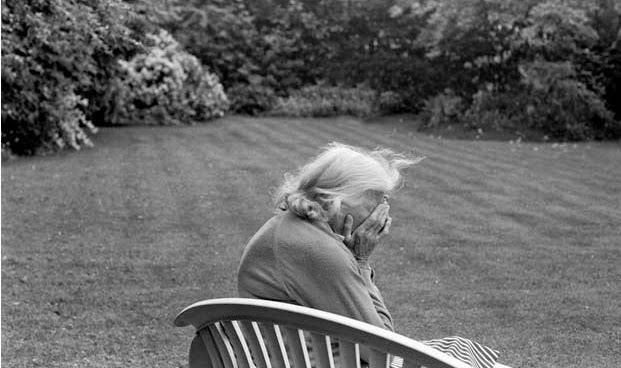
It is too late now for me to portray my parent's life together - the final reminder I have of my mother is a photograph of her sitting in the sun in the hospital garden, taken a couple of weeks before she died when she was too ill to notice or mind that I had taken a picture......
Friday, 3 April 2015
Pinhole Landscapes - Take 2
I recently uploaded some scans of various pinhole landscapes but hadn't actually printed any out. You can see some of them here and here. I spent a few days in the darkroom the other week and was surprised to see how well the prints turned out. They have a richness, drama and depth of tone completely lacking in the scanned negatives, which now look rather flat in comparison. Of course, looking at an actual print and looking at something on the screen is a completely different experience, but I had never really thought that there would be such a wide discrepancy between a scan of a print and a scan of a negative. Or perhaps it just demonstrates that my darkroom skills are superior to my Photoshop skills!
I now feel encouraged to continue developing my darkroom work and to expand my pinhole photography repertoire, perhaps exploring the urban landscape. I might even try colour......
Monday, 9 March 2015
Pinhole landscapes
After a gap of nearly a year, I took my pinhole camera out again last week. Of course, I had to go back to square one and re-familiarise myself with the instructions though being a very simple camera, it didn't take long! I used different film this time - a roll of Ilford HP5 about 15 years past its use-by date. This is not a film I use very often - I tend to prefer Kodak Tri-X - but it seemed to have suffered no ill effects and actually the results were pretty good. So far I've been using up whatever film I have to hand and most of it is out of date, so this is hardly a controlled experiment.
Looking back at my previous pinhole efforts, I noticed that a lot of the negatives were over-exposed and had to be heavily corrected in Photoshop. This time I cut the exposure right down and the resulting negatives are better. I've been using an app on the phone called Pinhole Assist to calculate exposure times. This seems to work really well and has built-in reciprocity curves for the longer exposures required for the pinhole, saving on having to work it out for yourself! I also took more care with the composition - the best results seem to be when there is something in the foreground close to the camera. I do really like the sense of depth in the images - you feel like you are being sucked into the photograph towards the vanishing point.
Some of the same scenes feature in a previous post where I used the Hipstamatic app on my iPhone. You can see them here and compare the effect - obviously quite different as the phone ones are very dark and dramatic whereas these are lighter and more ethereal, especially No 3 below which is actually a double exposure by mistake where I forgot to wind the film on. I will persevere with my efforts - the sense of satisfaction from using film, the concentration and mindfulness required, the feeling of being totally wrapped up in the moment can't be matched by the ease and instant results of digital!
Looking back at my previous pinhole efforts, I noticed that a lot of the negatives were over-exposed and had to be heavily corrected in Photoshop. This time I cut the exposure right down and the resulting negatives are better. I've been using an app on the phone called Pinhole Assist to calculate exposure times. This seems to work really well and has built-in reciprocity curves for the longer exposures required for the pinhole, saving on having to work it out for yourself! I also took more care with the composition - the best results seem to be when there is something in the foreground close to the camera. I do really like the sense of depth in the images - you feel like you are being sucked into the photograph towards the vanishing point.
Some of the same scenes feature in a previous post where I used the Hipstamatic app on my iPhone. You can see them here and compare the effect - obviously quite different as the phone ones are very dark and dramatic whereas these are lighter and more ethereal, especially No 3 below which is actually a double exposure by mistake where I forgot to wind the film on. I will persevere with my efforts - the sense of satisfaction from using film, the concentration and mindfulness required, the feeling of being totally wrapped up in the moment can't be matched by the ease and instant results of digital!
Tuesday, 3 March 2015
Drive By
Often when I'm driving along I get the urge to stop the car, leap out and take a photo. Obviously this is only practical if you are on your own! On numerous occasions I've been frustrated as I've been the passenger or else I have a passenger with me, or else I'm in a hurry or on a mission. I may return later only to find that the moment has passed, the light has changed or even that the subject has disappeared - the spontaneity of the moment has gone. Sometimes I may pass by a place regularly and not see its potential - then one day the play of light suddenly reveals its hidden beauty or spectacular clouds transform an everyday landscape. On go the brakes, out comes the camera....
Being inside the car is a bit like looking through a camera viewfinder - something about looking out of the windscreen, rear view or wing mirror and seeing the world ready framed. In his series America by Car, Lee Friedlander uses the car windows as a deliberate compositional device, the mirrors reflecting odd, unexpected fragments of the passing scenes.
From America by Car by Lee Friedlander
Todd Hido's photographs of lonely rainswept American roads are similarly shot through the car windscreen, the rain blurring and veiling the sombre landscapes.
From A Road Divided by Todd Hido
In the introduction to American Surfaces, Stephen Shore likens the effect of being in a car on a road trip to that of an 'explorer travelling in a bubble of familiarity'. Driving for extended periods puts him in 'a very clear and focused state of mind'. My journeys to the shops or visits to my father can hardly be compared to a road trip - we're not talking Robert Frank's The Americans here! But even on these short trips I find that driving is conducive to creativity - perhaps because there are few other distractions and the mind is fully engaged on the visual, or maybe it's just having the opportunity for some breathing space where the brain can empty itself of daily concerns.
From American Surfaces by Stephen Shore
The other day I found myself doing a U turn on a steep hill in the pouring rain just to take a photograph of a pair of roadside mirrors sitting incongruously on the edge of a wood! There is actually an assignment in the Photographer's Playbook by Steve Young which advocates doing just that:
U-Turn Rule
'Whenever you are driving, and pass something that makes you want to grab your camera, you must immediately pull a U-ey, go back, and shoot it. If you don't, you'll spend the next ten miles thinking about it, and then you'll have to add twenty miles to your trip.'Here are some recent photographs all taken while driving within a 15 mile radius of home.....
Subscribe to:
Posts (Atom)