Showing posts with label painting. Show all posts

Saturday, 11 April 2015

Yesterday in the artist's studio

Some pictures from yesterday when I ventured into the artist's studio again......


This is very much a work in progress, a constantly evolving record of a space in a state of flux. It has no natural beginning nor end and I'm not sure yet what I'm going to do with the images. I'll probably make them into a book at some point in the future but I also think it would be a nice idea to show them together with some of the paintings that were created in the space. A possible future husband/wife collaboration?

All paintings copyright Mike Newton

Saturday, 28 March 2015

Tools of the Trade


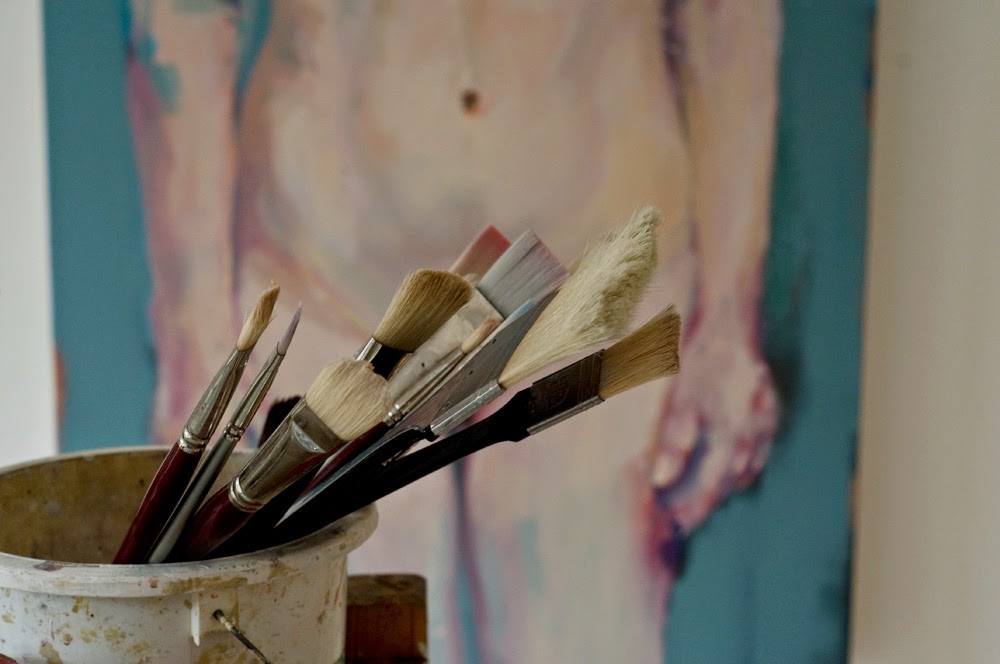
Another peek into the artist's studio - this time looking at the various tools of the trade: brushes and palette knives, paints and palettes, canvases and paper, books and magazines, plus a surprising number of feathers! Not sure if they're just for decoration or whether they actually get used. The brushes come in a wide range of sizes and shapes and each will have its own defined specialist use.

Having looked at quite a number of  pictures of artists' studios, they seem to fall into two camps - the super-tidy and the messy. This one is a very tidy one and reflects the owner's character. Each item has its place, brushes are meticulously cleaned after use, processes and experiments are all noted down. A feeling of order and calm pervades the space, even in the midst of the creative process.....


Saturday, 24 January 2015

Backs to the wall

Another peek inside the artist's studio.....

The works in today's post are all back views. Whether heads or figures, nude or clothed, the back view of a person hints at mystery, reverie and detachment. The viewer is unable to gauge the expression or can only partially do so if the face is in profile. The subject is usually portrayed as lost in thought, absorbed in some inner meditation, unaware of the viewer. We, the viewer, have to put our imaginations to work to fill in the gaps.

In painting, the Rückenfigur is the term used to describe a figure in the landscape, seen from behind, contemplating the view. The viewer is encouraged to place himself in the position of the Rückenfigur, so that he may experience the same sense of awe in the face of nature as felt by the figure in the painting. Associated with notions of the the sublime in nature, German romantic painters such as Caspar David Friedrich used this device to emphasise the spiritual and mystical aspects of the contemplation of nature.

The figures in the paintings featured below are not depicted in any communion with nature. In fact, we do not know what they are looking at. Nevertheless, their back views may lead us to suppose that their minds are on higher things, their thoughts turned in on themselves and the viewer is inspired to share their experience....


All paintings copyright Mike Newton
More of Mike's Rückenfigur work can be seen here and here

Monday, 19 January 2015

The Artist's Studio

"What would we not give to peer over the shoulder of Giorgione or Vermeer  - or Francis Bacon? In an age that has lost its natural sense of the numinous, we half believe that we could be the witness of a form of magic. And it is not only the enactment of that magic that so compels us; the place in which it is performed may be charged with a presence that compounds the spell. To enter the studio of Giacometti was to walk, like Alice, through the Looking-Glass, into a realm that seemed to change the scale of your own body; to find your way across the floor of Kitaj’s studio that is strewn with open books like paving stones in a Japanese garden is to step into the silent discourse of centuries between artist and artist; and to be invited into Brancusi’s lair at 11 Impasse Ronsin was to cross the threshold into a space that was itself a work of art in which sculptures of polished brass, white plaster and rough-hewn wood had been disposed in groups under the calm white light from high windows – a temple of trophies through which you moved as in a trance. In each case a way of working had moulded from within its own aura." 
          From The Artist at Work by Colin St John Wilson


These photographs are from a project about the artist's studio on which I've been working intermittently over the last year. I am lucky enough to have access to an artist's studio right here at home, where my husband works and produces his paintings and drawings. It is a fascinating place and offers different photographic opportunities virtually ever time I cross the threshold. The constant state of flux creates interesting and unusual juxtapositions of images as new work replaces work in progress or a finished piece. At times portraits seem to communicate with one another, at times willfully turning away, sometimes caught in a shaft of light, at other times expressions hidden in the shadows.   

I usually do my photographing there when the space is empty as I don't like to intrude. The studio is usually regarded as a place of sanctuary, a personal space which is not be invaded. In addition, I make it a rule never to disturb anything - I tend to prefer photographing what I come across rather than staging my pictures - and for me the serendipity of finding a ready-made still life is one of the great pleasures of photography. 

The images in this selection are all to do with the gaze - the painter's gaze of course, but also the gazes exchanged between the subjects of the paintings and their gaze as they look out at the viewer, as well as the viewer's gaze at both the paintings and the photographs. Gaze upon gaze upon gaze.....

To be continued........

All paintings copyright Mike Newton


Saturday, 26 January 2013

Disappointments.....

So often we look forward to an event, exhibition, or eagerly awaited new film or publication only to be let down by the reality. Conversely, some things we have little or no expectations of, either because we are unfamiliar with the artist in question or because we may even actively dislike their work. In these cases, we can be pleasantly surprised and even inspired.

A couple of weeks ago I spent a few days in London, rushing around trying to catch all the exhibitions I had been meaning to see before they close at the end of the month. Despite the best of intentions, it is usually the case that things are left to the last minute, as happens with most things in my life! I had been looking forward to Seduced by Art: Photography Past and Present at the National Gallery as it deals with the two genres of art I am most interested in - photography and painting - specifically the influence of the latter on the former and the elastic and fluid nature of the relationship between the two. I'm not saying it was a bad exhibition - just that I came out feeling rather underwhelmed. Perhaps some of it is down to the exhibition space in the basement of the Sainsbury wing - a cramped and rather claustrophobic place, the walls painted in dark colours with no natural light. It works for some exhibitions but I felt the walls crowding in on me as I jostled to see the work on display.

This was the National Gallery's first major exhibition of photography exploring both early photography from the 19th century and the work of contemporary photographers, presented together with historical paintings displayed according to the traditional genres of still life, landscape, portraiture and nudes. The trouble with this approach is that so often it doesn't really demonstrate a dialogue between the two at all - it is totally one-sided. The curators have gone out of their way to show that photography takes its inspiration from painting yet failed to demonstrate that it is very much a two-way process. There is no mention of the widespread use of the photographic image in painting nor any of the debate about photography's effect on the history of art. Surely the reality is that photography, just like all other forms of art - literature, music, sculpture, painting - is concerned with the same universal themes of love, life and death which have been the main source of inspiration for all artistic endeavour throughout the centuries.

Many of the photographs involving contemporary restaging of paintings border on the kitsch or in the case of 19th century photographers, display large doses of Victorian sentimentality. The relationship between painting and photography is better illustrated when the photographer, rather than trying to mimic or restage a painting, instead reinvents the subject matter to say something relevant to contemporary life, as in Luc Delahaye's massive US Bombing on Taliban Positions which chillingly represents modern warfare without showing any human presence. It was hung beneath a panorama of a 19th century battlefield complete with soldiers and cannons and the juxtaposition of the two spoke volumes.

The Battle of Jemappes 1821 by Emile-Jean-Horace Vernet


US Bombing on Taliban Positions 2001 by Luc Delahaye

I was particularly taken with a photograph by Finnish photographer Jurma Puranen of Goya's painting of the Duke of Wellington. The photograph shows the surface of the painting transformed by reflections of light, bringing to our attention hidden details, the marks of the brush and craquelure, intensifying the colours and the areas of light and shade, revealing and concealing different elements.  It is a fine example of the transformative power of photography - taking a subject a making something new with it. 

The Duke of Wellington, 1812-14 by Francisco Goya

Shadows and Reflections (After Goya), 2011 by Jorma Puranen

It was a major drawback that many of the paintings on show were a rather undistinguished selection. The opening room featured arguably the most dramatic display of large-scale photographs - Jeff Wall's The Destroyed Room, Tom Hunter's Death of Coltelli and Sarah Jones' The Drawing Studio - all inspired by Delacroix' magnificent painting The Death of Sardanapalus. Instead of the original, all we got to see was a small lacklustre copy of the great painting by a little-known artist - hardly guaranteed to inspire anyone! All in all, a show of mixed parts and missed opportunities, yet for all that, it is always good to see photography exhibitions of this size and scope. I can't help wondering though what purpose is served by this endless comparing and contrasting of the two artistic genres. Photography is well able to stand on its own two feet without any outside help!

 The Death of Sardanapalus 1827 by Eugene Delacroix

 The Death of Coltelli 2009 by Tom Hunter

 The Drawing Studio 2008 by Sarah Jones

The Destroyed Room, 1978 by Jeff Wall

The National Gallery, 1989 by Thomas Struth

 The Rosy Wealth of June, 1886 by Henri Fantin-Latour

Blow Up: Untitled 5, 2007 by Ori Gersht

 Signs of the Times, England, 1991 by Martin Parr

 Mr and Mrs Andrews, 1750 by Thomas Gainsborough

I deliberately avoided reading any reviews of the show before I went, so was surprised to see afterwards how varied they were, ranging from delight to ambivalence to outright vitriol (no prizes for guessing which critic this is!) For those of you who have seen the exhibition, you will no doubt have made up your own minds. For those of you who haven't, you'll just have to take my word for it!